Feed the Future Honduras Alliance for Economic and Environmental Resilience
Summary information
- Department: Latin America
- Location: Honduras
- Commitment: 50 days
- Desired start date: As soon as possible
- Under direction of: Country Director
Background:
At the Rainforest Alliance, we are building an alliance to create a better future for people and nature by making responsible business the new normal. To advance our mission, we focus on amplifying our impact on the ground through systemic transformation: change across the entire supply chain, change in the relationship between people and nature, and change within our own organization.
The Rainforest Alliance is recruiting a consultant or consulting team to conduct an Irregular Migration Analysis and develop an accompanying plan for the USAID activity entitled Feed the Future Honduras Alliance for Economic and Environmental Resilience (Coalición para la Resiliencia Economica y Ambiental—CREA). Through this activity, the Rainforest Alliance will strengthen the capacity and increase the income of at least 4,000 producers and 60 local companies in Honduras’ northern Atlantic region by implementing profitable business models, while restoring and protecting natural resources and ecosystems to increase their competitiveness and ability to sustainably create jobs.
The activity’s Theory of Change states that If USAID engages with local enterprises and producers in Honduras’ northern Atlantic region to strengthen value chains, diversify incomes, and develop profitable business models that restore and protect natural resources and ecosystems, then nature-based enterprises will become more resilient and competitive, providing economic opportunities—particularly for women and youth—that reduce incentives for irregular migration.
Objective:
The consultant will conduct an evidence-based analysis that identifies opportunities, challenges, and actions to reduce irregular migration and/or reintegrate returned migrants within the activity’s target regions. The analysis must be accompanied by a plan that includes activities and indicators to track progress in responding to these issues. The assessment and planning will take place across Honduras’ North Atlantic region, and will include analysis and discussions with relevant stakeholders, and recommendations for project implementation, monitoring, and evaluation.
The Irregular Migration Analysis and Plan must include, at a minimum:
- A description of the irregular migration and/or reintegration context of the Activity at the national and municipal levels, and, wherever possible, at the community and target population levels. This analysis should include known drivers of irregular migration and challenges facing especially vulnerable subgroups of migrants and/or returnees.
- A set of migration-related interventions aimed at reducing irregular migration and/or encouraging the reintegration of returned migrants to be incorporated into implementation. Observing Do No Harm principles to reduce perverse incentives for irregular migration and/or to protect returned migrants involved with the Activity is required. At a minimum, the plan must include a training and awareness agenda on irregular migration for staff, collaborators, and beneficiary groups.
- A discussion of the potential opportunities, challenges, and partners for migration-related actions is required, emphasizing CLA components and deliberate coordination among stakeholders (within and outside of the Activity’s influence) that enhance collective effects on irregular migration and/or reintegration.
- The Irregular Migration Analysis and Plan should be aligned with the activity MEL plan and should clearly articulate a theory of change (ToC) that links the activity’s results to reduction of irregular migration. The ToC must include proposed custom migration-related indicators at each appropriate level.
- Communication strategies, products and tools that highlight irregular migration and/or reintegration related efforts must be included.
Activities:
The scope of work should include at least the following activities:
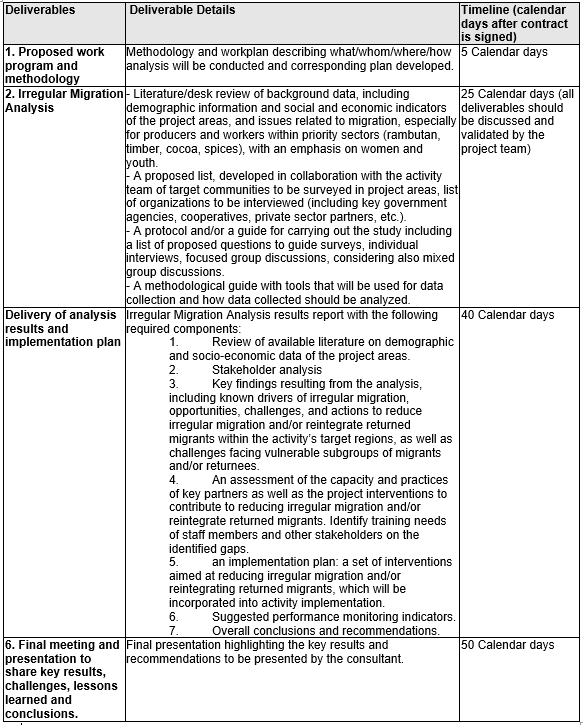
- Literature/desk review of background data, including demographic information and social and economic indicators of the project areas, and issues related to migration, especially for producers and workers within priority sectors (rambutan, timber, cocoa, spices), with an emphasis on women and youth.
- Conduct a stakeholder analysis to identify relevant local actors (government, NGO’s, communities-based organizations, etc.) that are involved in preventing irregular migration or supporting reintegration, migrant rights, and youth/gender inclusion, and identify relevant legislation related to migration.
- Conduct an irregular migration analysis and qualitative needs assessment of women, men, and youth in the project areas.
- Assess the capacity and practices of key partners as well as the project interventions to contribute to reducing irregular migration and/or reintegrate returned migrants. Identify training needs of staff members and other stakeholders on the identified gaps.
- Draft a report on the results of the Irregular Migration Analysis, including suggested performance monitoring indicators, and an implementation plan: a set of interventions aimed at reducing irregular migration and/or reintegrating returned migrants. These must consider marginalized and vulnerable population’s issues and mainstreaming gender equity, women, and youth leadership. The plan will be incorporated into activity implementation. This should include interventions to make sure that no-harm is done to the target populations.
Requirements
The consultancy requires an individual or a consultant firm, that can meet the following requirements:
- Experience designing and conducting social research (including individual and group interviews), information analysis, and developing recommendations.
- Fully Bilingual in English and Spanish.
- Assertive and empathetic communication skills.
- Professional background and experience on anthropology, migration, gender and social inclusion approaches, and their cross-cutting implementation.
- Experience developing high-quality reports in English and Spanish, based on the reporting requirements of bilateral agencies, like USAID.
- Experience working with diverse social groups, including women, youth, and Indigenous peoples in Honduras.
- Demonstrated ability to work with technical teams of different cultural backgrounds.
- Commitment to social justice, equity, and respect.
Expected Products
Application process and deadline
Submit application via the Hire Hive platform, uploading a PDF including a CV, a technical and financial proposal, along with other relevant materials for evaluation no later than 8 March 2024. IMPORTANT: Application submission due date extended to 15 March 2024.
Link Hire Hive https://rainforest-alliance-consultants.hirehive.com/development-of-an-irregular-migration-analysis-and-plan-various-locations-Qfgclo
Finalists will be notified by email and/or by phone.