
Terms of Reference: Firm to Conduct Project Merit Extension Endline Evaluation
Project Name: The Sustainable Agricultural Improvement Project
(Mejoramiento Agrícola Sostenible, or MAS+, in Spanish)
Agreement #: FCC-522-2017/023-00
Country: Honduras
Project location: Francisco Morazan, El Paraíso, Comayagua, Olancho, Yoro, and Cortes
Date: March 2024
Introduction:
These terms of reference outline the qualitative research activities related to data gathering, processing and analysis from households participating in the bean and coffee value chains (VC), to support a two year cost extension period assessment of the Sustainable Agricultural Improvement Project (hereinafter referred to as "MAS+"), funded by the United States Department of Agriculture (USDA) and implemented by TechnoServe.
TechnoServe
TechnoServe is an independent, non-profit, non-governmental organization that provides technical assistance and business advisory services to farmers and entrepreneurs from different countries in Africa and Latin America, including Honduras. TechnoServe's vision is a sustainable world where all people in low-income communities have the opportunity to prosper. TechnoServe's mission is to fight poverty by helping people build regenerative farms, businesses and markets that increase incomes.
2. Background
TechnoServe Honduras started the second phase of its Sustainable Agricultural Improvement Project (MAS+) in September 2017, funded by the United States Department of Agriculture (USDA) under the Food For Progress (FFPr) Program, with the objective of improving the family income of +34,000 small coffee and bean producers through technical assistance and direct links with buyers, through All Inclusive Marketing Contracts (AIMCS). MAS+'s area of influence included the following departments of Honduras: Francisco Morazán, El Paraíso, Comayagua, Olancho, Yoro, La Paz, Lempira, Cortes, and Santa Bárbara. MAS+ is a succession of the MAS (MAS 1.0) project which took place from September 2012 to September 2017, also funded by USDA FFPr, which supported 9,000 small coffee and bean producers in Honduras.
At the conclusion of the first five years of MAS+, TechnoServe conducted an external, experimental evaluation led by the International Food Policy Research Institute (IFPRI). The evaluation analyzed both qualitative and quantitative data from coffee farmers, and qualitative evidence from bean farmers.
USDA/FFPr approved a cost extension period currently underway (October 1, 2022 to September 30, 2024) improving the family income of +4,500 small bean producers, through technical assistance to increase yield and quality, and direct links with buyers, through All Inclusive Marketing Contracts (AIMCS). MAS+'s cost extension period area of influence includes: El Paraíso, Comayagua, Olancho, Yoro, and Santa Bárbara. Given that the midterm evaluation found that coffee activities have evolved such that they no longer need significant support from MAS+, those activities were scaled back significantly in the extension and the project provides only light-touch assistance to exporters to ensure that they are effectively managing relationships with coffee producers/POs, ensuring sustainability of the effective AIMS model beyond the life of the program (LOP).
TechnoServe seeks a consultant/consultancy firm to carry out data collection, processing and analysis activities for an additional qualitative assessment. As the cost extension is focused on beans, the assessment in this phase will also be qualitative, mirroring the bean component of the MAS+ final evaluation to facilitate comparisons while also capturing additional data on the new interventions. In the coffee value chain, the selected consultant will conduct semi-structured key informant interviews (KII) in the coffee sector, particularly with exporters, to document and share lessons learned on the AIMCS contract model and encourage other market actors to adopt similar models.
Data collection methods will include focus group discussions with participating producers and KIIs with stakeholders such as community seed bank (CSB) leaders, Government of Honduras (GoH) representatives, bean buyers, and financial service providers. The cost extension evaluation will also include an outcome harvesting exercise to assess uptake of new practices and changes in the behavior of external actors influenced by the intervention. For example, this exercise will examine the sustainability of transitioning bean seed/grain curricula to relevant partners and the effectiveness of transferring ownership/management of bean grain contracts to IHMA, and wholesalers.
The selected consultant will also conduct semi-structured key informant interviews (KII) in the coffee sector, particularly with exporters, to document and share lessons learned on the AIMS contract model and encourage other market actors to adopt similar models. The study will document: 1) what is working/not working during the 2023 coffee harvest without MAS+ support, 2) advantages/disadvantages of the AIMS model compared to the traditional purchasing system, and 3) how exporters manage working with a large number of producer organizations (POs)s.
The audience for this evaluation includes: USDA; project leadership and relevant practice areas/other projects across agriculture projects at TechnoServe; project partners and beneficiaries; and other relevant project stakeholders, including those outside the US and Honduras who would benefit from the findings. To that end, MAS+ will disseminate results in mid FY24, primarily through workshops and informal study tours with the Honduran Coffee Institute (IHCAFE) and visitors from other coffee-producing countries (representatives from coffee sector, producer organizations, coffee federations, coffee exporters, among others).
Final scope of work pending donor approval.
3. Summary of MAS+ merit extension Programmatic Activities
Note that the scope of the cost extension phase is smaller than under MAS+, but the activity number here remains the same as under the original project to facilitate comparison.
Activity 1: Training: Facilitate Improved Farmer Productivity. MAS+ implements a suite of on-farm training activities tailored to the specific needs of targeted farmers to facilitate improved productivity of bean parcels. The capacity building of Producer Organizations (POs) is also included in this activity.
Activity 5: Financial Services: Facilitate Agricultural and SME Lending. MAS+ strengthens Cajas Rurales, rural savings and loans groups, to facilitate access to finance at the PO level. The program continues to promote innovative agreement mechanisms that can successfully offset risk to exporters, such as factoring, input-supplier loans and harvest advances.
Activity 6: Market Access: Develop Buyer and Seller Relationships. MAS+ promotes marketing contracts among farmers and anchor firms. Our partners furthermore coordinate efforts with IHCAFE and the private sector to elevate international recognition of Honduran coffee quality.
Activity 7: Capacity Building: Government Institutions and Policy Regulatory Framework. TechnoServe provides technical assistance to the Honduran Ministry of Agriculture (SAG) to validate bean varieties that can help farmers improve yields, and other partners.
4. Evaluation Questions and Methodology
The purpose of the qualitative portion of the evaluation is to contextualize the situation of improving the technical capacity of the producers, as well as the progress and business development of the producers' organizations. The aim is to determine whether the project intervention is helping to improve farm management by incorporating new agricultural practices and technologies, and whether this has an impact on productivity and family income. Some key conclusions and recommendations of the first five years of MAS+ from the aforementioned evaluation conducted by IFPRI are shared as Appendix 10.
More specifically, the objectives of this qualitative study are to:
Beans:
- Qualitatively validate the results and sustainability of the activities implemented during the cost extension period that have increased crop´s volume and quality (technical assistance, farm visits, among others), access to markets, access to finance, and generate recommendations for improvements in similar future projects.
- Determine the relevance of the project in relation to the critical problems encountered in the bean sector in Honduras, the perceptions of project´s key partners about the relevance for their operations, sustainability, including a gender and youth focus.
- Indicate areas of success and identify bottlenecks, perverse incentives or other factors that may have influenced the project from reaching its goals.
- Determine impact and effect by identifying external factors that positively or negatively affected the program's progress.
Coffee
- Conduct semi-structured key informant interviews (KII) with coffee exporters who have worked with MAS+.
- Assess what is working/not working during the 2023 coffee harvest without MAS+ support, including the degree to which exporters are successfully managing relationships with a large number of producer organizations. What challenges, if any, have exporters had in working with producer organizations, and has their membership remained stable and engaged?
- Identify advantages and disadvantages of the AIMS model compared to the traditional purchasing system.
- Consider how the AIMS model can be made more sustainable and strengthened to continue driving community-level income increases (as observed at the endline).
- Did the coffee exporters develop access to financial products without TNS’ support during the cost extension period?
The above relates to the following questions from the USDA Food for Progress Learning Agenda (USDA Food for Progress Learning Agenda: Trade Expansion and Agricultural Market Development, July 2016):
- Question 14, for coffee: "What are the best linkage models to help small and medium-sized producers, traders, and post-harvest market players, who often lack collateral, registration, and credit history to access loans...or other financial instruments to effectively expand their businesses? "
- Question 15, for coffee: "Do cooperatives, associations, federations or collectives impact producers' abilities to optimize sales to local, regional or international markets? What services provided by cooperatives lead to results? What types of cultural environments are best for these different models to thrive?
- Priority Question 21: "In what context is it profitable for agricultural actors, particularly producers and processors, to adopt higher product quality standards for sales to higher value markets, including international markets?"
- Question 28, for beans: what are the best methods for improving the post-harvest stage of the value chain to maintain crop quality and value after harvest? What aspects of pre-harvest production, such as ensuring input quality and limiting pests and diseases, are most important for reducing post-harvest losses?
Interviews and focus groups
The Consulting Firm will be responsible for carrying out both interviews and focus groups, and developing detailed question guides for each. The interviews should be designed to understand how the activities had an impact from the perspective of the beneficiaries and to understand how they contributed to the achievement of the final results; as well as what types of restrictions the actors faced to achieve them. MAS+ will provide logistical support (3-4 vehicles) to transport the Consulting Firm´s team to conduct field activities (focus groups), will call on the farmers, and will pay for the expenses related to the focus groups (rooms, food, producer’s transportation, etc.).
In total, the Consulting Firm should plan to carry out 11 focus groups, and 9-12 key informant interviews. Further details are provided below:
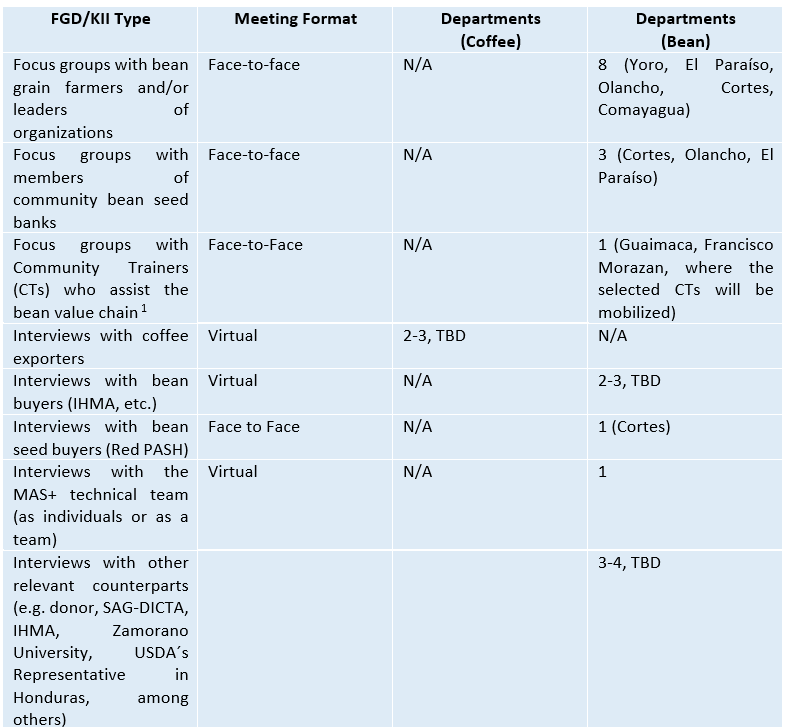
At a minimum, the selected proposal will include the review methods identified above. However, these methods are not considered sufficient to meet all the objectives of the review. Proposals must identify methods to respond to all objectives, comprehensively incorporating the methods identified in the evaluation plan. The content and the questions to be asked will be agreed between TechnoServe and the Consulting Firm. Support on organization and logistics for the aforementioned interviews and focus groups will be provided by TechnoServe.
Questions of interest
The consulting firm will be responsible for developing focus groups and key informant interview protocols. To facilitate this process, TechnoServe has prepared a list of questions of interest; note that as this list is extensive, not all of them will be addressed and/or covered with equal levels of detail in the qualitative evaluation.
Project design
- What are the problems/opportunities in bean chain producers that MAS+ sought to address?
- To what extent did the project reach its objectives and targets? What accounts for any significant shortfalls of planned achievements? (If any).
- Was the MAS’s theory of change adequate and accurate for the intervention? Were the assumptions in the theory of change valid during the implementation?
- How did the MAS management team respond to and implement the recommendations in the final evaluation related to the bean value chain?
- Are project activities being configured in a way that leads to sustained results through beneficiaries and partners? What is the evidence for this?
Technical capacity of producers
- What are the good agricultural practices, techniques, and technologies the producers adopted as a result of the MAS’s assistance?
- How did the efforts reflect an interest in including women and youth in the program's activities?
- Did the training and transfer of the good agricultural and climate smart/regenerative practices (crop management, harvest, post harvest, etc.) and technologies lead to an increased bean productivity and quality? Was there any reluctance to adopt specific practices?
- Do bean producers understand the value of using certified seed?
Access to Finance
- Do producers have a better knowledge of financial services available to them (financial institutions in their region, requirements/how to access, terms and conditions, etc.)?
- Has the loans´ information presented by the project been useful?
- Are producers able to see a difference in the interest rate of credit comparing the options presented by the project and informal sources (intermediaries)?
- Do producers find that they can access the credit options presented to them by the project? To what extent have they overcome constraints on land availability, reluctance to use certified seeds, and the timeliness of being paid? What has the project done/not done to address these constraints?
Project monitoring
- What, if any, were the project's negative results? How might they have been avoided? To what extent can these results be clearly attributed to Program's actions?
- Is there systematic monitoring of the performance of project indicators including: information flow, capture, analysis, sources of information and means of verification of indicators in general?
Gender:
- What results did the training modules on "family teamwork" or "empowering families" (gender) produce in the families and communities assisted? How effective have the new gender strategy (curricula, modules) been under the extension phase in driving more transformative change and responding to the final evaluation findings?
- Did MAS+ contribute to increasing women's participation in value chain activities (bean growing, quality control, marketing, etc.)?
Migration
- To what extent has the MAS+ project's services and accompaniment contributed to rooting the producers with whom you work in their communities of origin and preventing them from joining the international migration flows to the United States?
Public and Private Partners
- What activities carried out by the MAS+ Project have contributed or added value to the partners?
- What activities should the MAS+ Project improve for future interventions?
5. Scope of Work
Activities
The Consulting Firm is expected to perform the following activities (note that this is not an exhaustive list):
- Preparation of a data collection and quality assurance plan.
- Development of interview and focus group instruments, designed by target.
- Execution of data collection
- Carry out data analysis using qualitative data analysis techniques and using relevant technology (e.g. NVivo or similar) for coding and analysis, as necessary.
- Preparation of preliminary report
- Follow-up calls will be coordinated if necessary, which will be recorded as a means of feedback for the Consulting Firm. These reports must contain information on progress and particular challenges/cases that emerged during field work.
- Preparation of a final report.
Expected products
- Final workplan with schedule and routing, plus instruments for interviews and focus groups. The workplan should include:
• Methodological design of the study (including data analysis techniques and technologies) and plan of activities for the process. Describe in detail the methodology to be used in the study that includes the techniques to be developed for information gathering with each stakeholder.
• Instruments for data collection, designed by target. Note that these tools must be tailored to each stakeholder and must respond to the main activities of the program, as indicated above.
- Final data collection report
- Preliminary results report, with an outline of content and preliminary findings.
- Final report incorporating changes/final feedback from TechnoServe and USDA in accordance with the provisions of these terms of reference.
• A final technical document of the qualitative study. The document must incorporate relevant tables/summaries of the qualitative analysis, with recommendations for improvements, as well as extracting the lessons learned, successes and difficulties in carrying out the activities within the framework of the Project's results. The document will be delivered in English.
• Presentation of the study results. The presentation will be developed and coordinated with the participation of the key actors in the program, and will seek to socialize strengths and weaknesses to identify potential improvements or recommendations.
Selection Criteria and Process
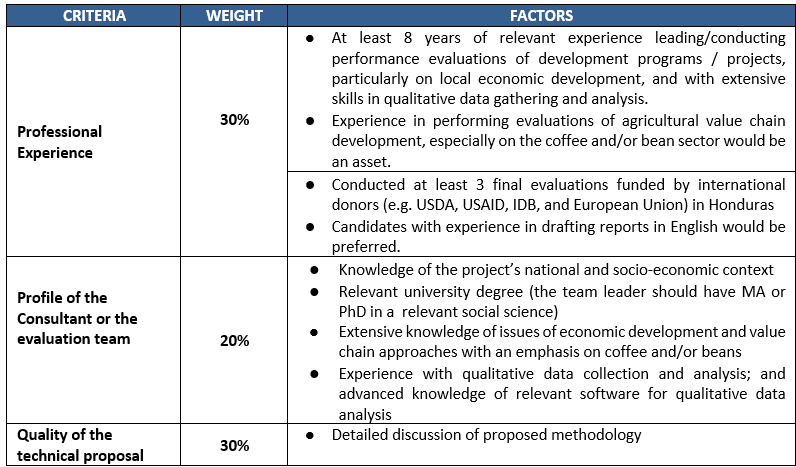
TechnoServe´s multidisciplinary team will review the submitted technical and economic proposals that meet the requirements. The evaluation and selection of the chosen proposal will be based on the following criteria and weighting:

Deadline for completion
The period of fulfillment of any contract arising from this TOR will be effective from approximately April 1, 2024 and end on or around June 30, 2024 (3 months distributed as follows: 3 weeks for planning and interview guide development; 1 week for pilot focus groups; 3 weeks for data collection; and the remaining time to develop preliminary and final reports and incorporate feedback). Proposals must detail the estimated timeframe needed to fulfill all obligations, with detailed estimates of implementation for each particular activity, as indicated in the/ “Expected Products” section of this TOR. Proposals that comply with all requirements, are rigorous in the proposed methodology, and propose an efficient yet realistic timeframe are desired.
General terms and conditions
- The Consultant or Consulting firm, and all parties constituting the Bidder, may have the nationality of any country. All national or international consulting firms or group of individuals acting as a Consulting Group must be legally constituted. In the event that the candidate is a natural person, the following principles apply:
- The Consulting firm will act in representation of a group of consultants;
- The Consulting firm will receive any remuneration from TechnoServe, to be distributed among the team members as they are defined;
- If the Consulting firm finds that any of their staff have committed serious misconduct or low performance, then the consultant shall provide in a timely manner, as a replacement a person with qualifications and experience acceptable to TechnoServe. Penalties will apply if the Consultant does not remedy a failure in the performance of their obligations under the Contract.
- A bidder must meet all requirements of an independent evaluator indicated in Part 7 CFR 1499.13, articulated in USDA Foreign Service Evaluation Policy. These requirements include but are not limited to:
- [Independent evaluator] uses acceptable analytical frameworks such as comparison with non-project areas, surveys, involvement of stakeholders in the evaluation, and statistical analyses;
- Uses local consultants, as appropriate, to conduct portions of the evaluation; and,
- Provides a detailed outline of the evaluation, major tasks, and specific schedules prior to initiating the evaluation.
A bidder must not have a conflict of interest. Bidders who are found to have conflict of interest shall be disqualified. Bidders shall be deemed to have a conflict of interest with one or more parties in this bidding process if they are or have been associated, directly or indirectly, with a company or with any of its affiliates which have been hired by TechnoServe to provide consulting
- services for the preparation of the design, technical specifications and other documents to be used in the tender for the acquisition of goods subject to these bidding Documents.
- The Request for Proposal is not and shall not be considered an offer by TechnoServe.
- All responses must be received on or before the date and time indicated on the RFP. All late responses will be rejected.
- All unresponsive responses will be rejected.
- All proposals will be considered binding offers. Prices proposed must be valid for the entire period indicated in the RFP.
- All awards will be subject to TNS contractual terms and conditions and contingent on the availability of donor funding.
- TNS reserves the right to accept or reject any proposal or cancel the solicitation process at any time, and shall have no liability to the proposing organizations submitting proposals for such rejection or cancellation of the request for proposals.
- TNS reserves the right to accept all or part of the proposal when award is provided.
- All information provided by TNS in this RFP is offered in good faith. Individual items are subject to change at any time, and all bidders will be provided with notification of any changes. TNS is not responsible or liable for any use of the information submitted by bidders or for any claims asserted therefrom.
- TNS reserves the right to require any bidder to enter into a non-disclosure agreement.
- The bidders are solely obligated to pay for any costs, of any kind whatsoever, which may be incurred by bidder or any third parties, in connection with the Response. All responses and supporting documentation shall become the property of TNS, subject to claims of confidentiality in respect of the response and supporting documentation, which have been clearly marked confidential by the bidder.
Information for Submitting Bids
Interested and qualified parties who intend to submit a proposal for this RFP are asked to confirm their intent by emailing [email protected] by Thursday, March 14th. The letter of interest should include the following information: Name of the consultant or consulting firm, contact information and a brief summary of their experience and work developed during the last 5 years related to the actions required by TECHNOSERVE. Applicants who express their intent to submit a proposal by this deadline may request access to the results framework and final evaluation.
Interested parties who submit their letter of intent will receive a proposed number and location of the required focus groups, which will help them for the technical and economic proposal.
Questions regarding this RFP must be submitted in the link on TechnoServe’s website for this RFP, and must be received no later than Sunday, March 17th. Responses to all questions will be appended to the link on TechnoServe’s website for this RFP no later than Monday, March 18th.
Candidates meeting the aforementioned criteria must address their economic and technical proposals to the attention of email indicated in the TechnoServe’s website for this RFP, with the subject line “Proposal for TechnoServe MAS+ Qualitative Evaluation,” no later than 11:59 pm EST on Sunday, March 24th. Note that bids must be submitted in Spanish language. Complete all the requested appendixes. The economic proposal must be presented in US Dollars. Provide the requested payment terms and conditions. The documentation submitted must include the name of the bidding company, physical address, contact name, job position, electronic mail, mobile and fixed phone number.
Proposals received after the deadline will not be considered, and time extensions are not available for any reason.
Means of verification of expenses
The means of verification to approve the payment or reimbursement of expenses related to personnel and logistics are described below:

Expenses for field personnel and their respective food will be made according to the daily rate defined in the final budget and based on the lists and attendance. Logistics expenses will be recognized according to the supporting documents presented (attendance lists, invoices for accommodation and generic receipts for transportation).
Quality retentions
- TechnoServe will pay the Consulting Firm no later than 15 calendar days after TechnoServe's written approval of the contractor's request for payment and TechnoServe's representative's approval of the deliverables corresponding to the requested payment.
- TechnoServe will provide written feedback or recorded virtual calls to the Consulting Firm regarding the quality of each final product, specifically in regard to the clear and understandable presentation of the data analysis and written reports, that the observations made are corrected, and will provide up to three opportunities to address feedback.
- If the Consulting Firm fails to correct the observations or findings on each deliverable in the first three opportunities, TechnoServe will retain 5% of the every payment agreed for quality assurance, that is, the payment of this 5% will not be made to the consulting firm of the corresponding payment according to what is stipulated in this contract, even TechnoServe approves the deliverable after the three opportunities to correct the observations or findings.
Examples of quality deficiencies include inconsistencies in the quantitative analyses, inconsistencies between the qualitative data and what is described in the reports, lack of indicated remedies, among others.
Payment Schedule and Terms
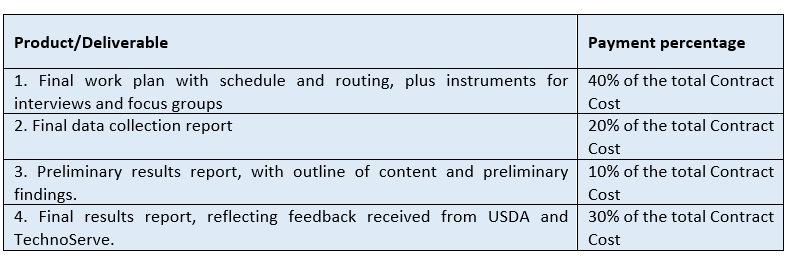
The form of payment for this consultancy will be carried out in proportion to and upon contractor delivery and TechnoServe approval of each of the following deliverables:
Timeline
(Note that this timeline includes qualitative and quantitative data collection activities for context, although this TOR only pertains to the former.)
Appendix 1. Guide for the preparation of the technical proposal and work plan
The technical proposal must define the focus of the evaluation, the activities necessary to carry it out, the methodology to be used for the activities of each product/deliverable, and the expected times for the completion of each phase of the consultancy. The proposal must be complemented by a preliminary evaluation work plan – see Appendix 4.
In response to this invitation, interested candidates in submitting a technical and economic evaluation proposal should consider all the aspects outlined in the Terms of Reference (ToR), such as, context/background to the assignment, specific objectives of the evaluation, approach and methodology, and activities. The offer must be presented in Spanish. An evaluation proposal should include the following:
- A cover letter (maximum 1 page).
- Brief introduction, objectives of the consultancy (maximum 2 pages)
- Description of the experience of the consultant or firm carrying out final evaluation studies, with special emphasis on qualitative data gathering, analysis and report writing of verifiable projects (programs, type of projects) (maximum 3 pages).
- Outline of the evaluation design, methodology and general evaluation approach, including assignment of roles across the work team and specific approaches for data analysis. (maximum 10 pages)
- Organizational chart of implementation unit (maximum 1 page).
- CVs of the evaluator and evaluator team, outlining previous evaluation experience and accomplishments as it relates to demonstrating the skills and knowledge needed to fulfill the requirements of the Terms of Reference. (Please attach an ID document). See the required template in the appendixes.
- Proposed work plan and timetable (must detail all the activities that will be carried out in each phase of the consultancy, maximum 2 pages).
- Schedule of activities
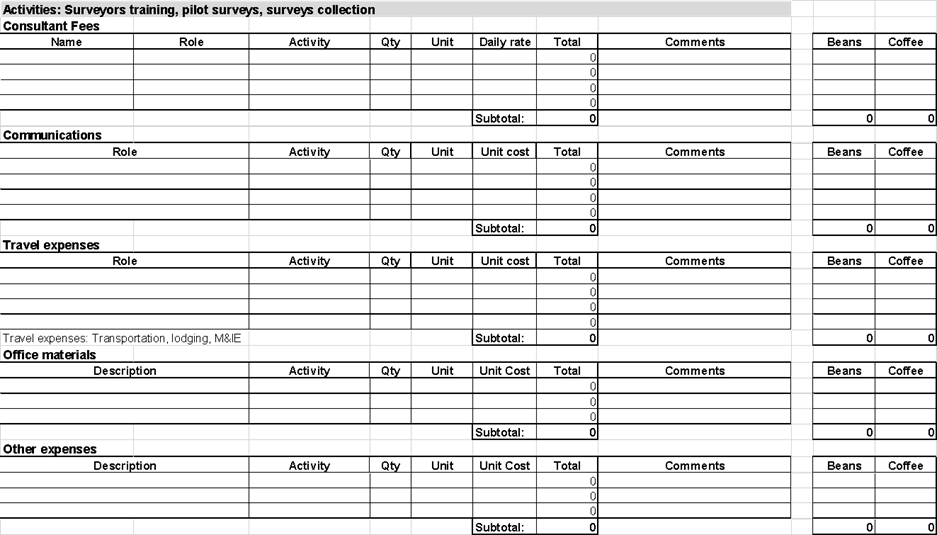
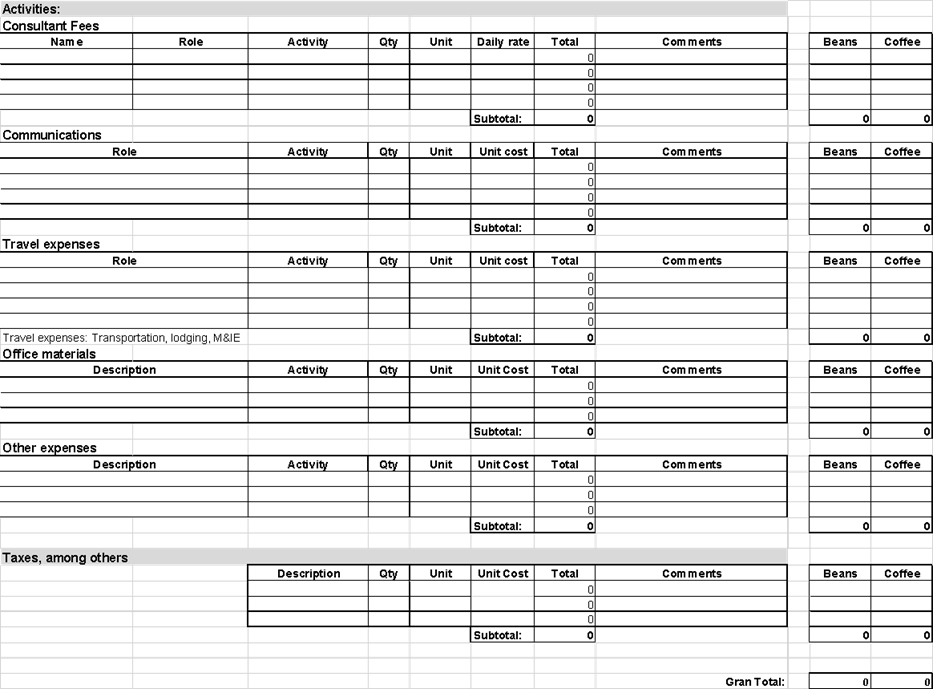
- Summarized Budget – you must indicate the breakdown of expenses (eg fees, per diem, transportation, etc.). You will also need to submit the document in Excel with the formulas linked (do not use Excel as a word processor).
- Other issues that the consultant/team of consultants deems relevant
Appendix 2. Consultant’s Experience and References
Relevant services carried out in the last 5 years that best illustrate qualifications:

Appendix 3. Team Composition and Assignment of Responsibilities

Appendix 4. Work Plan and Calendar of Activities

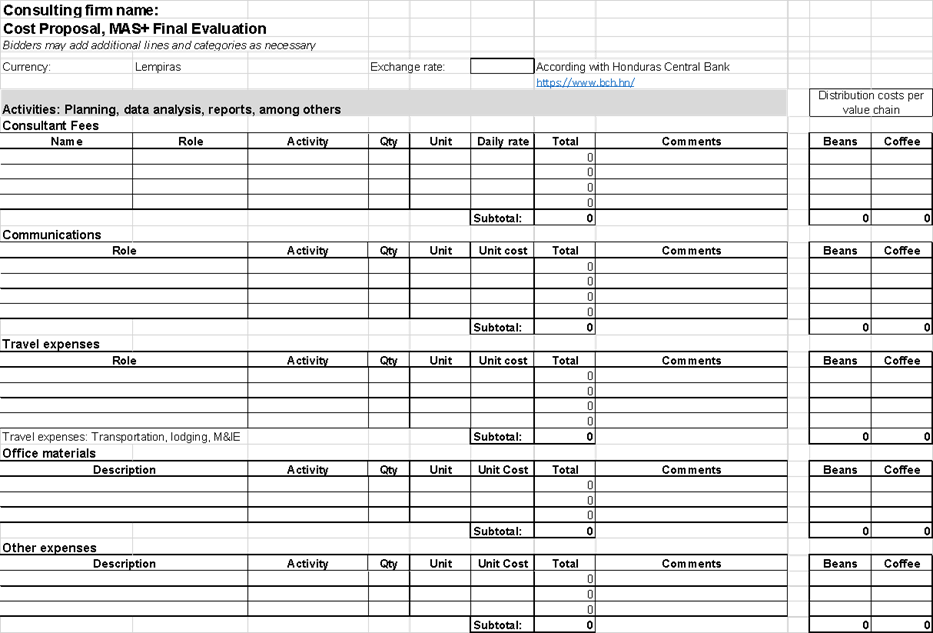
Appendix 5. Breakdown of the Contract Price
Expressed in Local Currency. The following format will be shared in Excel to the Consulting Firms that submit their letter of expression of interest.
Appendix 6. Eligible and Ineligible Expenses
Liquidation of expenses is understood as the presentation of documents that attest to all those expenses incurred for the development of the function of project consulting team or company.
Eligible expenses are:
- Transportation: Fuel, toll charges, internal transfers (bus, taxi), tire repairs, car wash, vehicle rental, and any other related expenses that may arise to move from the office to the place of destination prior authorization of TechnoServe.
- Food: Food expenses incurred for consulting activities.
- Communication: Sending documents, fax, internet, telephone for local calls.
- Lodging: Accommodation expenses.
- Miscellaneous: Purchases of minor equipment and office supplies, prints, photocopies, among others.
Ineligible expenses are:
- Personal expenses such as personal items, medicines, laundry, medical consultations, etc.
- Entertainment expenses such as cinema, discos, recreation places, etc.
- Alcoholic beverages.
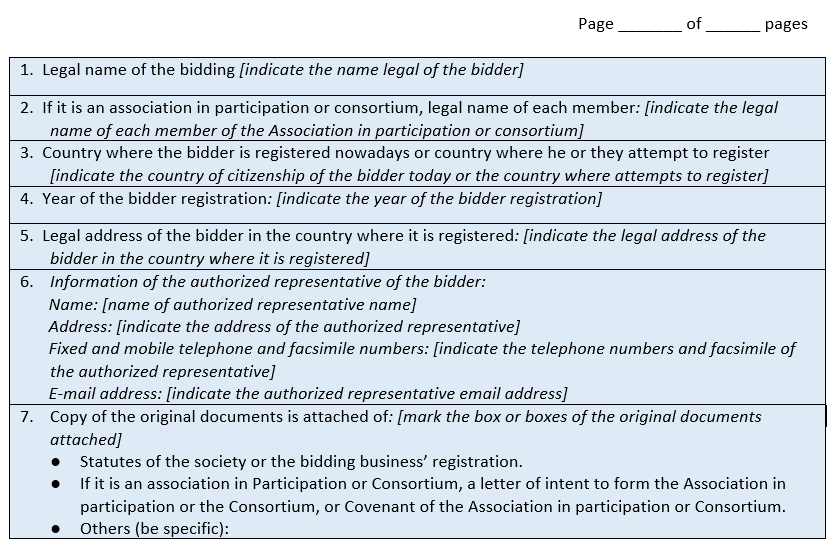
Appendix 7. Information Template of the Bidders Information
[The bidder must complete this template according to the following instructions. Any alteration to this template will not be accepted nor substitutes will be accepted.]
Date: [indicate the date (day, month and year) of the presentation of the offer]
Appendix 8. Bid Template
[The bidder will complete this template according to the instructions provided. [No alterations are allowed in this template nor will accept substitutions.]
Date: [Indicate the date (day, month and year) of the presentation of the offer]
Alternative Number [indicate the identification number if this is an alternative offer]
A: [Buyer's full name]
We, the undersigned, declare that:
- We have examined and not find any objection to the tender, even amended documents numbers __________________ [indicate the number and the date of issuance of each amendment];
- We provide the following goods and related services in accordance with the tender documents and in accordance with the Plan of deliveries set in the list of goods: ______________________ [indicate a description short of those goods and related services];
- The price total of our offer, excluding any discount offered in the following category (d) is of: __________________ [indicate the total price of the offer in words and figures, indicating the respective amounts in different currencies];
- The discounts offered and the methodology for their application is:
Discounts. If our offer is accepted, the following discounts will be applicable: ______________________ [detail each discount offered and the specific item in the list of goods to which the discount applies].
Methodology and Application of Discounts. The discounts will be applied according to the following methodology: ______________ [detail the methodology that will be applied to the discounts];
(e) Our offer will remain valid for the period of ___ days, from the date limit set. This offer will force us and may be accepted at any time before the expiration of such period;
(f) If our offer is accepted, we commit to obtain a Fulfillment Guarantee of the Contract in accordance;
(g) The undersigned, including all the requested subcontractors or vendors to execute any part of the Contract, have the nationality of the eligible countries _______________ [indicate the nationality of the bidder, even that of all the members comprising the bidder; if the bidder is an association in participation or consortium, and the nationality of every subcontractor and vendor]
(h) We do not have a conflict of interests of conformity with those detailed in the bidding description;
(i) Our company, its affiliates or subsidiaries, including all the subcontractors or vendors to execute any part of the Contract, have not been declared ineligible according to the list in the tender;
(j) The following commissions, bonuses or fees have been paid or will be paid in relation to this tender or the execution of the Contract: [Indicate the full name of each recipient, their complete address, the reason for which each Commission or bonus is paid and the amount and currency of each Commission or bonus]
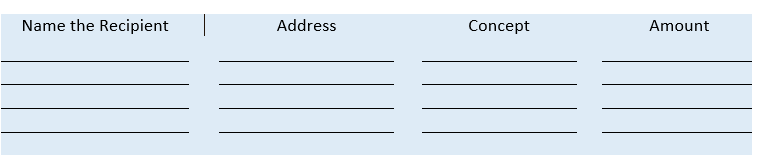
(If they have not been paid or will be unpaid, indicate "none".)
(k) We understand that this offer, along with its proper acceptance in writing, included in the notification of award, shall constitute a contractual obligation between us, until the formal Contract has been perfected by the parties.
(l) We understand that you are not obliged to accept the lowest evaluated bid or any other offer received.
Signature: ______________ [indicate the full name of the person and position played]
In the condition of ____________ [indicate the legal capability of the person signing the offer template]
Name: __________ [indicate the full name of the person that signs the offer template]
Duly authorized to sign the offer for and on behalf of: [indicate the full name of the bidder]
The day ________________ of the month ___________________ of the year __________ [indicate the date of the signature]
Appendix 9. Declaration of Validity of the Offer
[The bidder shall complete this template of Declaration of maintenance of the offer in accordance with the provided instructions.]
Date: [indicate the date (day, month and year) of presentation of the offer]
A: [indicate the full name of the buyer]
We, the undersigned, declare that:
We understand that, in accordance with their conditions, the offers must be supported by a statement of maintenance of the offer during 60 calendar days.
We accept that we will be automatically declared ineligible to participate in any bid for contract with the buyer for a period of five years, counted from the date in which the award is notified, if we violate our obligation (s) under the terms of the offer if:
(a) We retreat our offer during the offer period specified by us in the offer template; or
(b) If after having been notified of the acceptance of our offer during its validity period, (i) we do not execute or refuse to execute the template of the Convention of Contract, if it is required; or (ii) if it is there is information that is different from the one provided in the tender documents.
We understand that this Declaration of Validity of the Offer will expire if we are not selected, and when the first of the following facts occurs: (i) if we receive a copy of its communication with the name of the bidding selected; or (ii) have elapsed thirty days after the expiration of our offer.
Signed: [signature of the person whose name and capacity is indicated].
In the capacity of [indicate the legal capacity of the person that signs the Declaration of validity of the offer]
Name: [full name of the person signing the statement of maintenance of the offer]
Duly authorized to sign the offer for and on behalf of: [full name of the bidder]
Dated of ____________ day of ______________ of 2022 [indicate the date of the signature]
Official stamp of the Corporation (if applicable)
[Note: in case of an association in participation or consortium, the statement of validity of the offer shall be in the name of all the members of the Association in participation or consortium that presents the offer].